Login
Login 

 HR
HR  HU
HU  PL
PL  RO
RO  SK
SK  SL
SL  CS
CS  SR
SR  UK
UK 


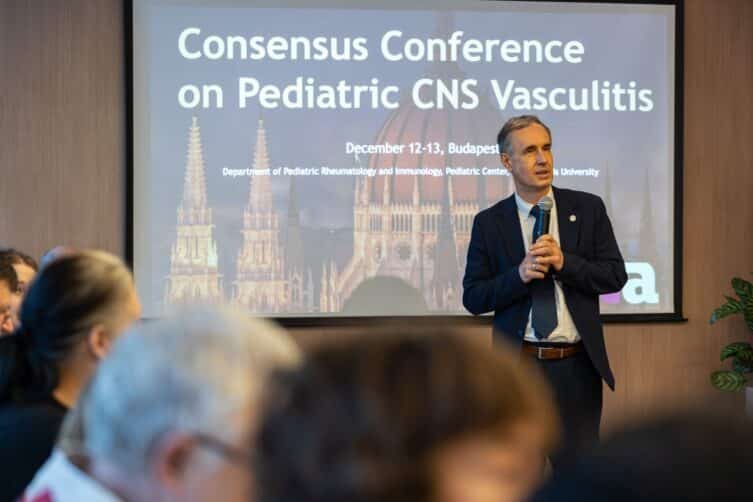
Budapest Hosted the First Artificial Intelligence-Supported Expert Consensus Conference
On December 12–13, the Department of Pediatrics of Semmelweis University organized the first international consensus conference on childhood central nervous system vasculitis (CNS vasculitis). During the two-day event, 54 international experts from 18 countries, representing 7 different medical specialties, participated in developing common guidelines for the diagnosis and treatment of this rare and severe group of diseases.
Why is this disease important?
In contrast to adults, where atherosclerosis is the leading cause, childhood stroke is most commonly caused by inflammation of the cerebral blood vessels. Central nervous system vasculitis is an inflammatory disease affecting the blood vessels of the brain and spinal cord, which, if left untreated, can lead to permanent neurological damage or death. Although childhood stroke itself is rare, the majority of affected children suffer from an underlying inflammatory disease.
The symptoms of the disease may mimic other neurological disorders, significantly complicating early recognition. Currently, there are no unified international diagnostic and therapeutic guidelines, resulting in delayed diagnosis and varying treatment practices worldwide.
Dr. Tamás Constantin, organizer of the conference and pediatric rheumatologist at Semmelweis University, highlighted: “In the field of rare diseases, it is particularly important to bring together dispersed expertise and establish unified guidelines. Through the use of artificial intelligence, we were able to make this process significantly more efficient, while decision-making remained entirely in the hands of human experts.”
Unprecedented international collaboration across multiple specialties
The conference was realized with the support of the European Reference Network for Rare Immunological, Autoinflammatory and Autoimmune Diseases (ERN-RITA). The participating experts represented seven different medical specialties: pediatric rheumatologists, pediatric neurologists, radiologists, immunologists, a neurosurgeon, a hematologist, and a patient representative also took part in the work.
In a unique way, the conference combined traditional consensus methodologies (Nominal Group Technique and the Delphi process) with the most advanced artificial intelligence technologies.
Pioneering application of artificial intelligence in clinical research
The Budapest conference is internationally novel in its application of artificial intelligence. The entire systematic literature review and the development of the AI tools were carried out by the Pediatric Rheumatology Working Group of Semmelweis University.
Systematic literature review supported by AI – Prior to the conference, a comprehensive systematic literature review was conducted in four major databases (PubMed, Embase, Scopus, Cochrane), using independent double review. From 7,842 records, approximately 200 relevant publications were ultimately identified. Artificial intelligence tools also supported the process.
Parallel expert and AI analysis – The selected literature was subjected to parallel expert and AI analysis, enabling comparative evaluation of conclusions generated by human experts and artificial intelligence.
Literature chatbot for experts – The working group made available to participants a specially developed chatbot, “Julie,” based on Retrieval-Augmented Generation (RAG) technology. This system contains the entire processed literature and allows experts to access the latest research findings instantly through natural-language questions during discussions.
Based on the review of the available literature, this is the first time that artificial intelligence has been applied with such depth and complexity in pediatric clinical research to support the development of consensus guidelines.
Conference outcomes
Following the two-day work, participants reached consensus on:
- diagnostic pathways for childhood CNS vasculitis,
- evaluation of imaging studies,
- treatment algorithms.
The results will be published in international scientific journals and will serve as official recommendations of the ERN-RITA network throughout Europe.
The conference in numbers
- 54 international experts
- 18 countries (Europe, North America, Middle East)
- 7 medical specialties
- 7,842 publications screened
- ~200 scientific articles analyzed in detail
- 2 days of intensive work
- 1 patient representative as an ERN-RITA ePAG delegate
The conference was realized with the support of the European Reference Network for Rare Immunological, Autoinflammatory and Autoimmune Diseases (ERN-RITA).
More posts